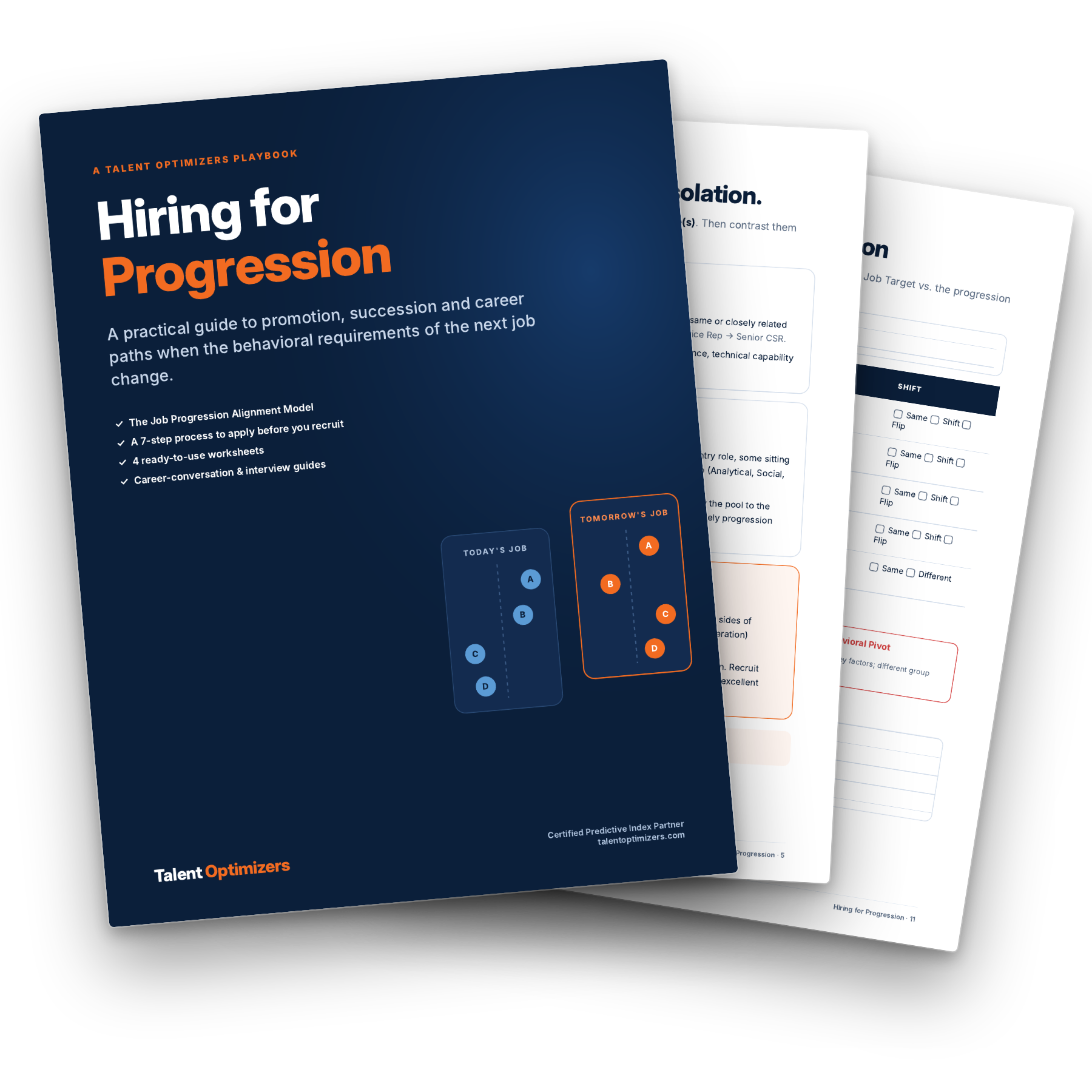
Stop turning your best performers into unhappy managers.
Your best employee today may not be your best employee in the job you're preparing them for tomorrow. This 15-page playbook shows you how to see the behavioral change in the next role before you make the promotion.
The Job Progression Alignment Model: Continuity, Adjacent Stretch, Pivot
A 7-step process to apply before you recruit
4 ready-to-use worksheets and an interview guide
Get the free playbook
The Peter Principle, measured
Organizations promote their best performers. But a promotion often isn't a more senior version of the same job — it changes what the job asks of someone every day. Get it wrong and you pay twice: you lose a great performer and gain a struggling manager.
38843
salespeople analyzed
131
U.S. companies
1553
promoted into management. Their prior sales performance was negatively correlated with how well they managed.
A model, a process and the tools to use them
Promotion is a hiring decision. This playbook gives you the same rigor internally that you apply when you hire externally.
Measure the behavioral distance
Build Job Targets for the entry role and every likely next role. Then classify each route as Behavioral Continuity, Adjacent Stretch or Behavioral Pivot, with a hiring strategy for each.
Apply it before you recruit
A 7-step process: build the current Job Target, map the progression routes, measure the distance, hire for today's job, and develop for the stretch before the promotion happens.
Use it this week
Four worksheets: a progression route map, a behavioral distance comparison, a promotion decision scorecard, and a career conversation and stretch plan.
Hire for today's job. Understand tomorrow's job. Develop for the distance between them.
Download the free Hiring for Progression Playbook and see where your promotion paths stretch, or pivot, before you make the call.