

Understanding the Four Forces of Disengagement — and How Predictive Index Helps Fix Them
Discover the four forces of employee disengagement and how Predictive Index Diagnose helps identify engagement gaps and turn insights into action.
3 min read
.jpeg)
Employee engagement surveys are everywhere. Lattice, Glint, CultureAmp, Gallup, Qualtrics — the list just keeps growing. But here’s the real question leaders should be asking:
Are these tools actually helping you improve engagement… or are they just collecting data?
In this blog, we break down how The Predictive Index (PI) Diagnose Engagement Survey stacks up against the competition — and why it may be one of the most overlooked, high-impact tools in the HR tech market.
If you prefer a more detailed analysis, I’ve also recorded a deeper breakdown. You’ll find the link in the comments.
Most engagement surveys provide useful data — scores, benchmarks, trends — but stop short of telling leaders what to actually do with that information.
PI Diagnose is different.
It’s rooted in behavioral science and designed to translate engagement data into clear, actionable leadership recommendations. Instead of just reporting what your people are feeling, it helps you understand why they're feeling that way and what to do next.
Before we highlight what makes PI Diagnose unique, let’s look at the major players many organizations consider.
These platforms offer strong survey capabilities and intuitive dashboards. But their engagement features are largely data-first — meaning they provide numbers and summaries, not tailored guidance for leaders.
Great tools, but often missing the “now what?”
Glint recently scored high praise in Forrester’s Employee Experience report. It’s a powerhouse platform for enterprise organizations.
However, its primary focus remains surveying and measurement, not behavior-driven solutions or step-by-step improvement plans.
Gallup is renowned for deep research and insight-driven analytics. But it comes with enterprise-level pricing and less flexibility for organizations that want custom, agile engagement approaches.
A brilliant analytics engine, ideal for large-scale enterprises that need complex data modeling.
But for many HR teams, Qualtrics is more horsepower than they need — and often requires additional tools or consulting to translate insights into action.
These platforms offer strong flexibility and good benchmarking.
But like many engagement tools, they still fall short on helping leaders turn insight into cultural change.
Among a crowded field, PI Diagnose offers a distinct advantage — it’s built from the ground up to be action-oriented and rooted in behavioral science.
Here’s what makes it different:
PI Diagnose doesn’t just tell you what people said.
It helps you understand why they feel the way they do.
This connection between behavioral data and engagement results is unmatched in the market.
This is PI’s superpower.
Leaders don’t have to decode analytics or run workshops to interpret data. PI Diagnose gives specific, practical steps leaders can take to improve engagement, team dynamics, and culture.
With packages starting around $7,500/year, organizations get enterprise-level insights without enterprise-level costs.
For many, it becomes a replacement for multiple tools, reducing tech stack complexity.
Instead of juggling multiple engagement, culture, and performance tools, PI offers:
Strategy alignment
Behavioral insights
Team analytics
Engagement measurement
Leadership coaching guidance
One ecosystem. One language. One workflow.
This is perhaps the most overlooked differentiator.
PI Diagnose helps leaders connect engagement drivers to strategic priorities — meaning the outcome isn’t just better survey scores… it’s better business performance.
There are dozens of excellent survey platforms. Many provide clean UIs, robust dashboards, and helpful analytics.
But if you want a tool that:
Explains why engagement looks the way it does
Tells leaders exactly what to do next
Connects engagement to strategy
Is backed by behavioral science
Helps you actually improve culture and performance
Predictive Index Diagnose is the one to beat.
Have you used an engagement platform before?
What’s been your biggest challenge turning data into action?
Drop your experience in the comments — I’d love to hear which tools you’ve tried and what you’ve learned.
And if you found this comparison helpful, follow along for more Predictive Index insights, practical leadership guidance, and deep dives into the tools that actually move the needle.
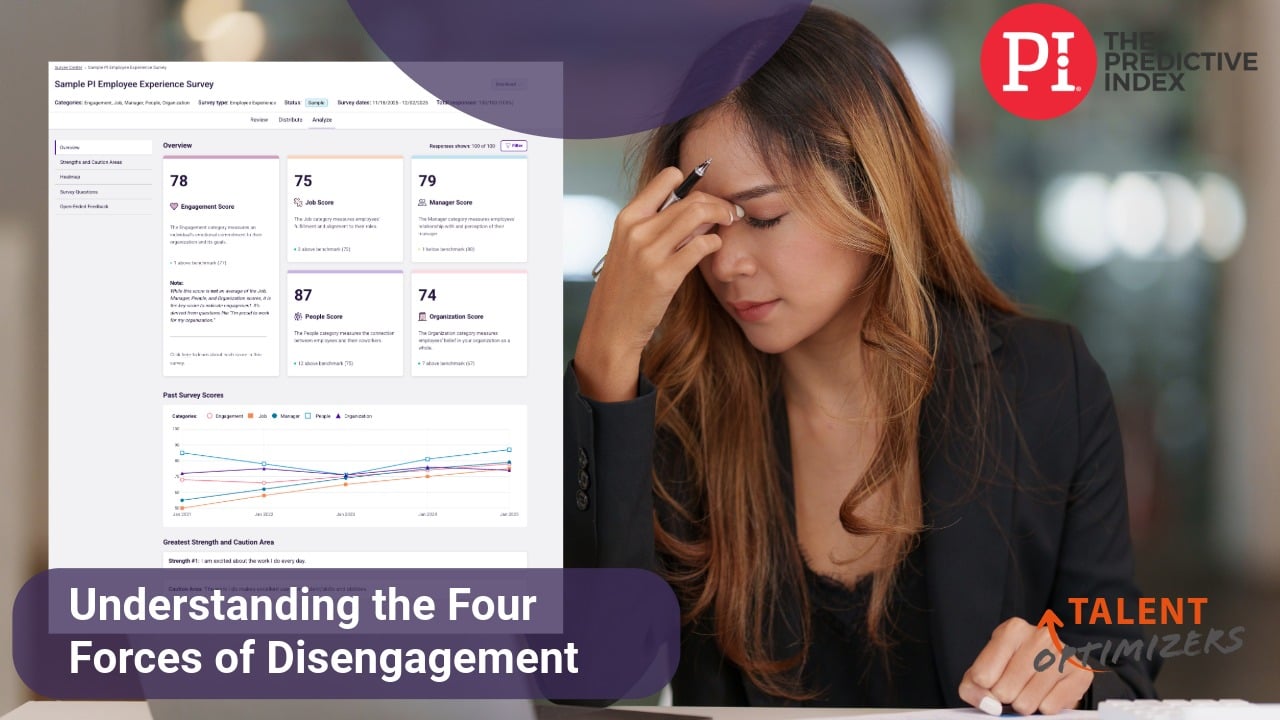
Discover the four forces of employee disengagement and how Predictive Index Diagnose helps identify engagement gaps and turn insights into action.

Why transformations fail isn’t strategy—it’s people. Explore HBR insights and how behavioral data helps leaders drive real, lasting change.
.jpeg)
Learn why relying solely on the PI star rating in Predictive Index Hire can be misleading and discover practical ways to dig deeper into candidate...