3 min read
PI Reference Profiles Explained: Why the Predictive Index Uses Them, How They're Built, and How to Use Them
Damon Clark : Nov 5, 2026, 5:10:18 PM
You just took the PI Behavioral Assessment. Your results came back with a name on them: Maverick, Operator, Strategist, Collaborator. Most people read the name, nod, and move on.
That is where most of the value gets lost. The name is not a label. It is a shortcut to a pattern, and the pattern is what tells you how you work, what drains you, and how you will land with the people around you. Here is how Reference Profiles actually work, and how to use them properly.
Watch first: the complete guide in one video
If you only have ten minutes, start here. This PI Hacks video walks through every part of this article.
Watch on YouTube · Subscribe to PI Hacks
Why PI uses Reference Profiles at all
The PI Behavioral Assessment measures four primary behavioral drives:
- Dominance (A): the drive to exert influence over people and events.
- Extraversion (B): the drive for social interaction with other people.
- Patience (C): the drive for consistency and stability.
- Formality (D): the drive to conform to rules and structure.
Those four factors are precise, but they are not easy to talk about in a busy team meeting. "Your A sits well above your B and your D is below the mean" is accurate. Nobody remembers it on Monday.
Reference Profiles solve that problem. They turn a four-factor pattern into a name that people remember, share and use. That is the whole point: a common language for behavior that works in 1:1s, team meetings and leadership offsites, not just in HR.
How Reference Profiles are built
The PI science team identified 17 Reference Profiles by analyzing millions of Behavioral Assessments. Each profile is a prototype: a typical shape of the four factors relative to each other.
When you take the assessment, your factor scores act like coordinates. PI compares your pattern to all 17 prototypes and assigns you to the one closest to your pattern. Three things follow from that:
- It is the shape that matters, not any single score. Where your factors sit relative to each other drives the profile.
- Profiles are neighborhoods, not exact addresses. Two people with the same profile can have noticeably different patterns.
- Some people sit on the line. A pattern can fall almost exactly between two profiles, and two near-identical patterns can land in different ones. Always read the full pattern, not just the name.
Does it hold up? In a 2019 PI study, 3,535 people rated how accurately their results described them. The average was 4.4 out of 5.
The four groups and 17 profiles
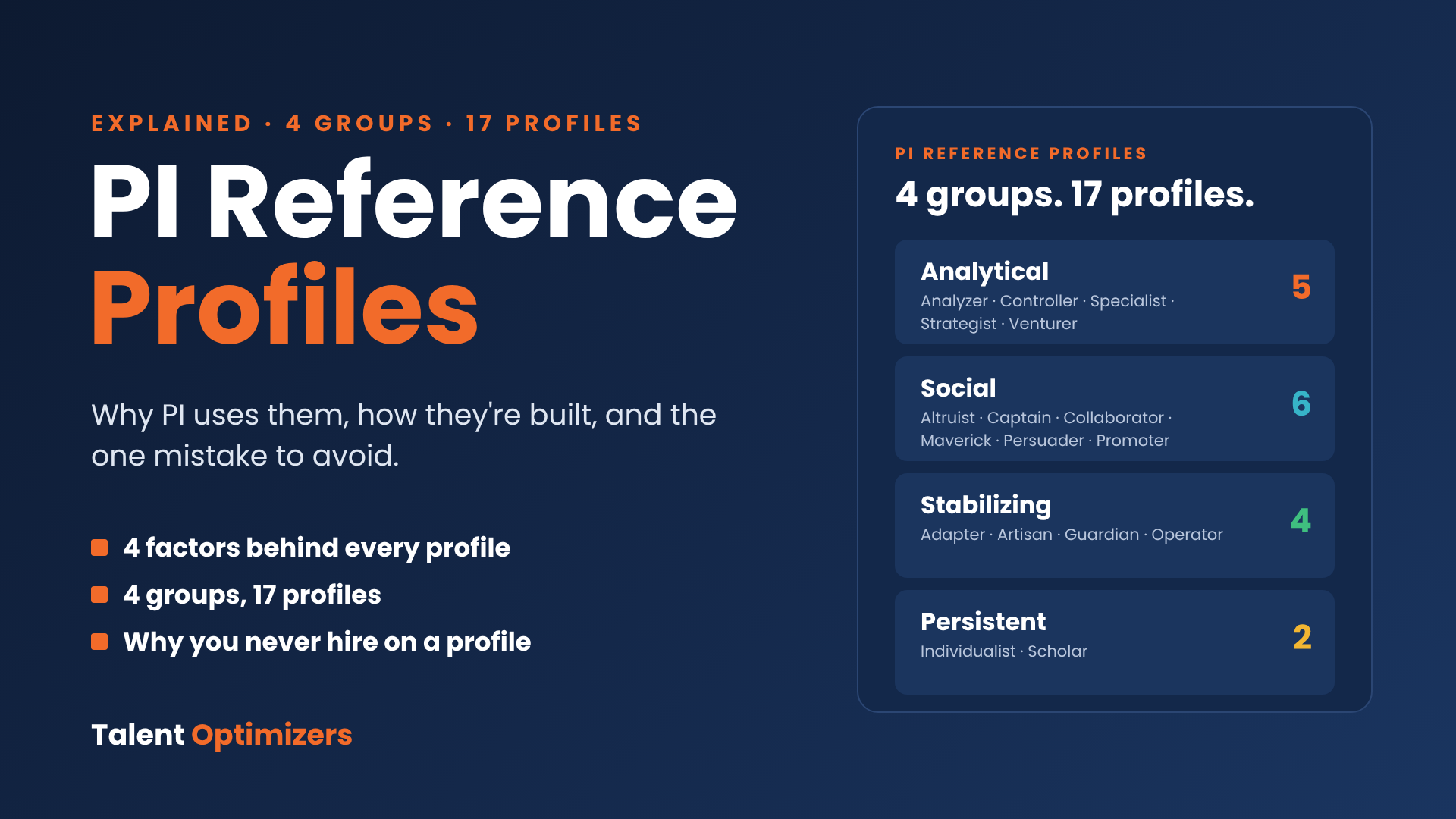
The 17 profiles sit in four groups, based on the drives they share.
Analytical (5 profiles)
More dominant than extraverted, low patience. Task-focused and fast-paced.
Analyzer, Controller, Specialist, Strategist, Venturer
Social (6 profiles)
Highly extraverted. People-oriented and outgoing.
Altruist, Captain, Collaborator, Maverick, Persuader, Promoter
Stabilizing (4 profiles)
Less dominant and extraverted, higher patience and formality. Steady, and at their best with structure.
Adapter, Artisan, Guardian, Operator
Persistent (2 profiles)
More dominant than extraverted, with high patience. Task-oriented and deliberate.
Individualist, Scholar
Across a sample of 10 million profiles, the most common are Collaborator (10.0%), Promoter (9.8%), Operator (9.4%), Altruist (8.4%) and Guardian (8.2%).
Free download
All 17 Reference Profiles on one page.
What drives each profile, how they communicate, and how to manage them. Keep it next to your desk for your next readback or 1:1.
Get the 17 Reference Profiles guideThe advantages: why this matters beyond your own results
- A shared language. "I'm a Venturer, so give me the headline first" saves weeks of trial and error between a manager and a new hire.
- Faster, better readbacks. The profile gives you a starting point. The pattern gives you the detail.
- Team-level insight. Put a team's profiles side by side and the friction points and blind spots become obvious. That is what PI Design does at scale.
- Self-awareness that sticks. People remember their profile name for years. They rarely remember a factor chart.
- AI coaching that knows your people. PI's AI coach, Obi, uses each person's behavioral data to help managers prepare conversations, give feedback and manage conflict.
The one mistake to avoid
Do not hire on a Reference Profile. PI is explicit about this: Reference Profiles are not used to make hiring decisions or calculate fit. Hiring in PI is done against a Job Target, built from what the role actually demands, and compared with the candidate's full pattern.
"We only hire Captains for sales" is a shortcut that screens out great people. Behavior is one input. Experience and motivation matter too, which is why we use the Head, Heart & Briefcase model alongside PI.
How to put your profile to work this week
- Read your full pattern, not just the name. Note your highest and lowest factors.
- Share it with your manager or team. Tell them what energizes you and what drains you.
- Learn your team's profiles. The PI Readback Toolkit includes a guide, worksheet and all 17 profiles.
- Go deeper on the factors. The PI Hacks library has a short video on every factor, every factor combination, and every Reference Profile.
From one profile to a whole organization
One assessment tells you about one person. The real return comes when your managers hire, coach and build teams with the same behavioral data. That is what the Predictive Index platform is built for, and it is what we help organizations do every day.
Thinking about PI for your organization?
Request a free talent strategy session.
We look at your hiring, management and team challenges and show you where behavioral data would make the biggest difference. No pitch deck. Fill in the short form and our team will be in touch.
Request your session