6 min read
You bought Predictive Index to hire better. Eighteen months later, recruiters open it, managers don't, and the leadership team has never looked at its own data. That isn't a software problem. It's a partner problem.
Most mid-sized companies sign up for PI with one job in mind, usually hiring. But the platform is built to cover the whole talent cycle: who you hire, how you manage them, how teams are designed and how leaders align around a strategy. When nobody helps you connect those pieces, you pay for the full platform and use a slice of it. A good PI consulting partner closes that gap. This guide sets out what that work should look like, so you can judge any partner, including us.
Quick answer: which Predictive Index consulting services should a mid-sized company choose?
Choose a certified PI partner who covers six areas, not just hiring: hiring quality, workforce planning, leadership team alignment, manager coaching, employee engagement, and training with a clear implementation plan. Talent Optimizers, a certified Predictive Index partner serving 60+ clients worldwide, works across all six, starting with a 90-day implementation roadmap and roughly one trained PI Champion per 50 employees.
60+
PI clients we work with worldwide
1 per 50
trained PI Champions to employees
90 days
to a working PI implementation
34
checks in our free PI Value Checklist
Why does a mid-sized company need a Predictive Index partner at all?
Because PI only pays back when people use it in everyday decisions, and that takes more than a login. Companies of 50 to 1,000 people rarely have a full-time talent team to design job targets, train managers, run team sessions and keep adoption going when the PI admin changes roles. A partner brings that capacity and the know-how, then hands it over to your own PI Champions.
We see the same pattern across our 60+ clients. The ones getting real value aren't the ones with the biggest subscription. They're the ones where PI shows up in interviews, one-to-ones and leadership meetings.
The 6 areas PI consulting should cover
1How does Predictive Index consulting improve hiring quality and reduce mis-hires?
By making the hiring decision about the job first and the candidate second. Most mis-hires start before anyone applies, when the hiring team never agreed what the role really needs. A PI partner should run a job target alignment meeting with the hiring manager and stakeholders, then build interviews around the gaps between the candidate and the target.
PI is one input, never the whole decision. We use our Head, Heart and Briefcase model so behavioral fit (Heart) sits alongside cognitive ability (Head) and experience and skills (Briefcase). It's also how you use assessments responsibly. We cover that in Adverse Impact in Hiring and Behavioral Profiles vs Competencies.
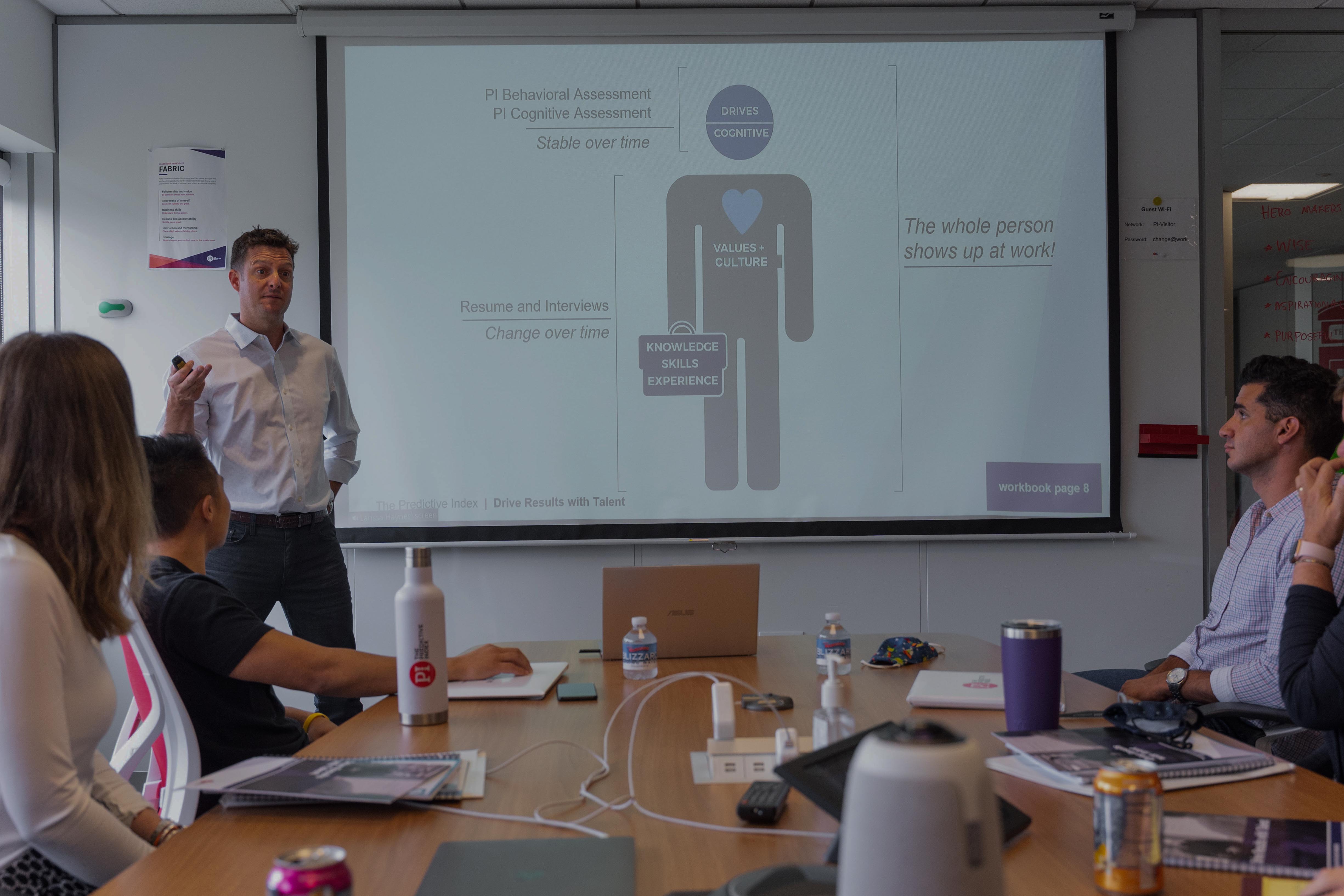
Damon Clark walking a hiring team through the Head, Heart, Briefcase model: the whole person shows up at work.
Don't hire on PI alone: the Head, Heart, Briefcase model, from PI Hacks.
Try the free Head, Heart & Briefcase hiring tool
2How can Predictive Index help with workforce planning?
PI helps you plan around behavior, not just headcount. Workforce planning usually asks how many people you need. PI adds what kind of people, and whether the people you already have can grow into the roles you're planning. Three uses matter most for mid-sized companies:
- Team design. PI Design shows a team's type and its blind spots before you add or move people, so a new hire fills a real gap.
- Promotion planning. The next job often needs different behaviors from the current one. Measuring that distance before you promote is the subject of Hiring for Progression.
- Change and reorgs. Retaking the PI Self-Concept after a role changes shows, person by person, whether the change has landed. See How to Retake the PI Self-Concept.
Try this: before your next planning cycle, pull the PI Design view for each team you plan to grow. Write down the one behavior each team is missing, and hire for that first.
3How does PI consulting improve leadership team alignment?
By giving the leadership team a shared, objective picture of how it works, then tying that picture to the strategy. Every Talent Optimizers engagement starts with our Introduction to High-Performing Teams workshop. It's a half-day session that benchmarks the team across 27 competencies, picks its three highest-impact priorities and sets a shared team goal with owners and KPIs.
From there we add PI and The Five Behaviors of a Cohesive Team where they help, and our Line-of-Sight strategy work where the team needs to turn priorities into 90-day goals and scorecards. We're operating-system agnostic. If you already run EOS or Scaling Up, we work alongside it rather than replacing it.
Build high-performing teams with The Five Behaviors and PI, from PI Hacks.
A PI subscription is a tool. A PI partner is the plan for using it.
4How do you get managers coaching with Predictive Index results?
Train them on PI Inspire, then put PI in front of them at the moment they need it. Managers don't forget PI because they dislike it. They forget it because the profile lives in a report they never reopen. Good consulting fixes that in three steps:
- Teach the readback. Every manager should be able to plan and give a PI readback to their own team members.
- Use Obi before hard conversations. Obi, PI's AI coach, turns the data into advice for the one-to-one in front of them.
- Coach the stretch. The gap between someone's Self and Self-Concept shows where they feel the job is asking them to stretch. That's where coaching pays back most.

Coaching managers to use PI data in real conversations, not just read the report.
5How does Predictive Index support employee engagement and retention?
Through better fit between people, roles and managers, and through teams that actually talk about their differences. Top performers rarely leave over one bad day. They leave when the job keeps asking them to be someone they're not, and nobody notices. PI gives managers the language to notice.
The fastest lever we know is social. Profiles read alone get forgotten. Profiles discussed as a team become a shared language. Our PI team building activities are built to make that happen in 20 minutes at the start of a team meeting.
Why top performers leave, and how to fix it with PI, from PI Hacks.
6What should Predictive Index training and implementation support include?
A plan, the right people trained, and someone who owns success. Certification on its own isn't an implementation plan. Our standard has four parts:
- An executive sponsor in the C-suite who owns PI's success.
- PI Champions: roughly one trained Champion per 50 employees, so PI doesn't die when one admin moves on.
- Role-based workshops: PI Professional Certification for Champions, plus PI Hire, PI Inspire and PI Design training for hiring managers, managers and leaders.
- A 90-day roadmap from Foundation to Activation to Optimization. It's set out in our PI Implementation Playbook.
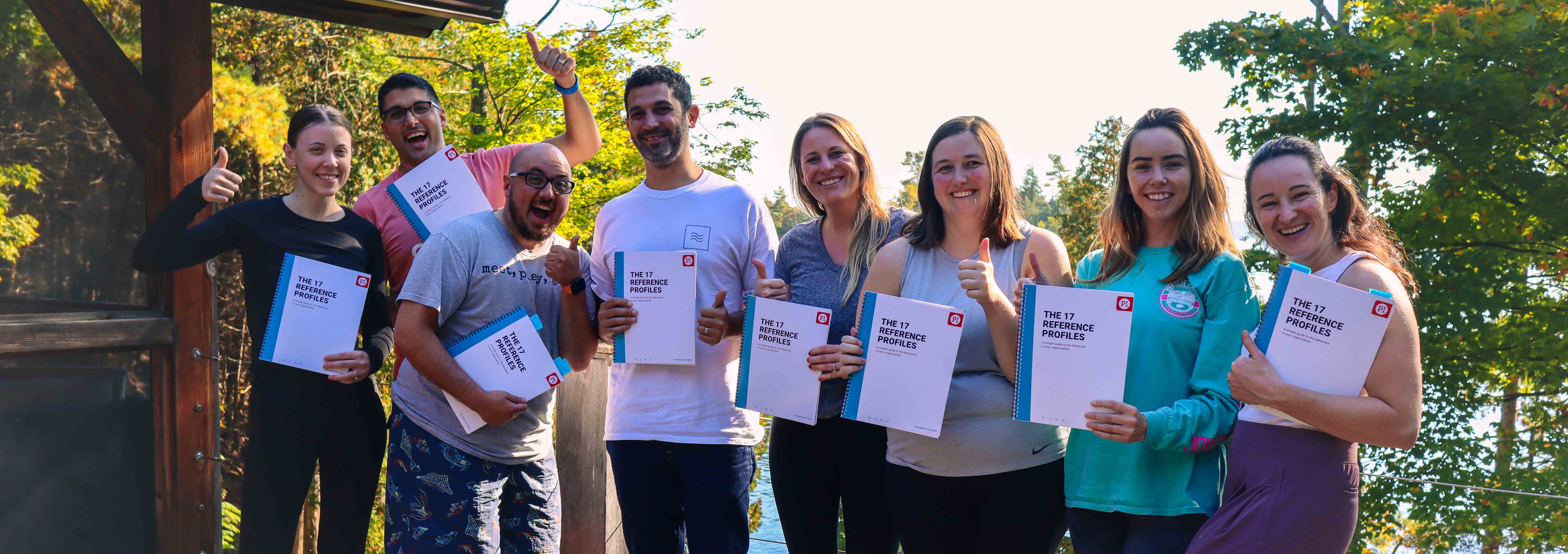
A team after one of our PI workshops, every one of them now able to read and use the 17 Reference Profiles.
Already using PI? Start by scoring where you are today.
How should a mid-sized company choose a Predictive Index partner?
Judge partners on what happens after the contract is signed, not on the assessment itself, because every certified partner sells the same PI software. Ask these six questions:
- Do you work across hiring, managing, team design and leadership, or mostly hiring?
- What does your implementation plan look like for the first 90 days?
- How will you train our managers, not just our PI admin?
- How do you work with our leadership team and our existing operating system, such as EOS or Scaling Up?
- What learning resources can our people use between sessions?
- Can you support us in every country where we operate?
For the last two, we're open about our answers. We run PI Hacks, the largest PI-focused YouTube channel, and our free PI resources hub is open to everyone. We've worked across the US and Canada, the UK and Ireland, Europe and the Middle East.
Free for mid-sized companies
Not sure where PI fits in your business? Talk it through with us.
A free 60-minute consultation: a deeper look at your hiring, managers and leadership team, and clear recommendations on where PI will pay back first.
Book your free PI consultationRelated reading
About the author: Damon Clark is CEO of Talent Optimizers, a certified Predictive Index partner serving 60+ clients worldwide, and runs PI Hacks, the largest PI-focused YouTube channel. He previously worked at The Predictive Index.