

Why Trust Is the Foundation of High-Performing Teams
Learn how trust drives high-performing teams and how The Five Behaviors and Predictive Index help leaders build stronger, more aligned teams.
6 min read
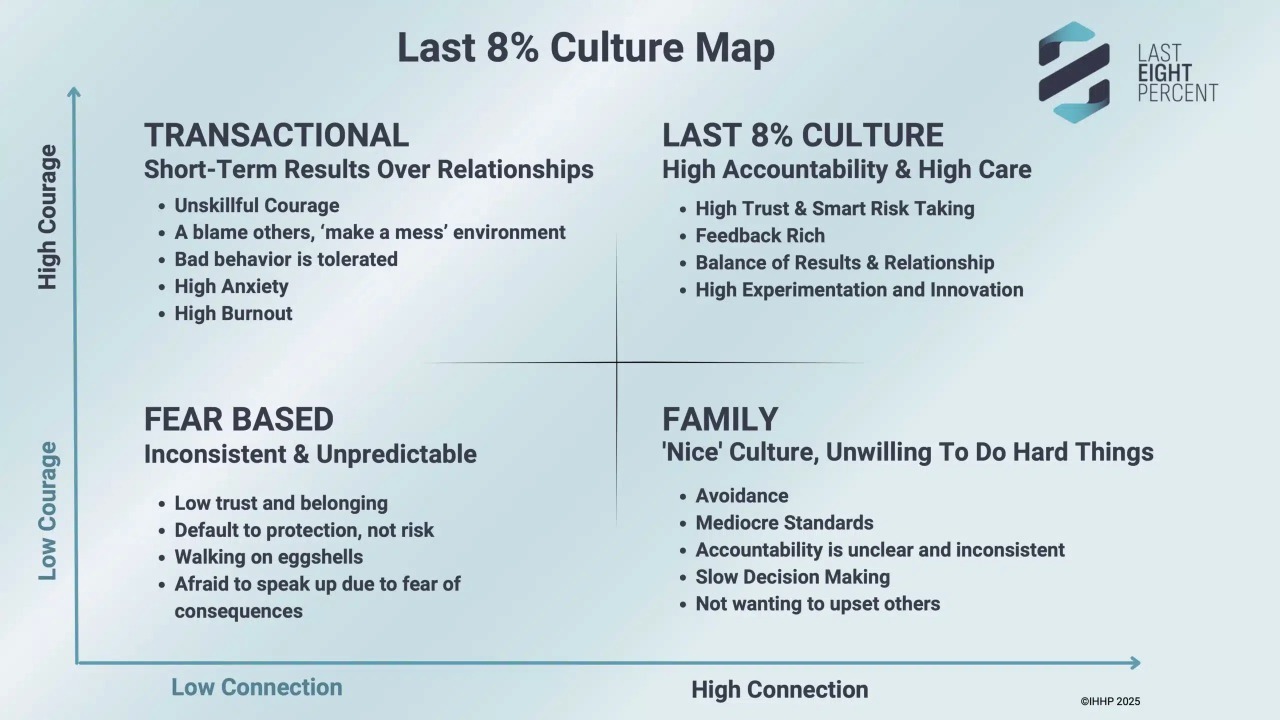
High‑performing teams don’t fail because of a lack of strategy, talent, or ambition. More often, they fall short because people hold back — avoiding difficult conversations, soft‑pedalling feedback, or staying silent when something feels off. According to research popularised by JP Pawliw and the Institute for Health and Human Potential, this gap is known as the Last 8%: the most uncomfortable but most critical part of conversations, decisions, and actions that people routinely avoid.
This concept, explored in The Secret to Building a High‑Performing Team, highlights a powerful truth: performance lives at the intersection of trust and courage. When teams can close that last 8%, they unlock speed, innovation, accountability, and resilience.
In this blog, we’ll explore:
What a Last 8% culture really is
How it connects directly to The Five Behaviors of a Cohesive Team®, particularly Trust and Conflict
How The Predictive Index® (PI) enables organizations to build this culture by improving behavioral awareness, communication, and team dynamics
Research across tens of thousands of employees shows that, on average, people withhold around 8% of what they really want to say — especially when stakes are high. This might be the honest feedback a colleague needs, the concern about a risky decision, or the challenge to a leader’s thinking.
The research identifies two essential pillars required for people to consistently step into that discomfort:
Connection – People feel valued, heard, and psychologically safe
Courage – People are expected, enabled, and supported to do hard things
When both are present, teams develop what’s known as a Last 8% culture: high connection and high courage. This is where trust deepens, accountability becomes normal, and healthy conflict drives better outcomes.
Without these pillars, teams tend to fall into less effective patterns:
Family cultures (high care, low challenge)
Transactional cultures (high challenge, low care)
Fear‑based cultures (low care, low challenge)
Each of these erodes trust and makes conflict either unsafe or unproductive.
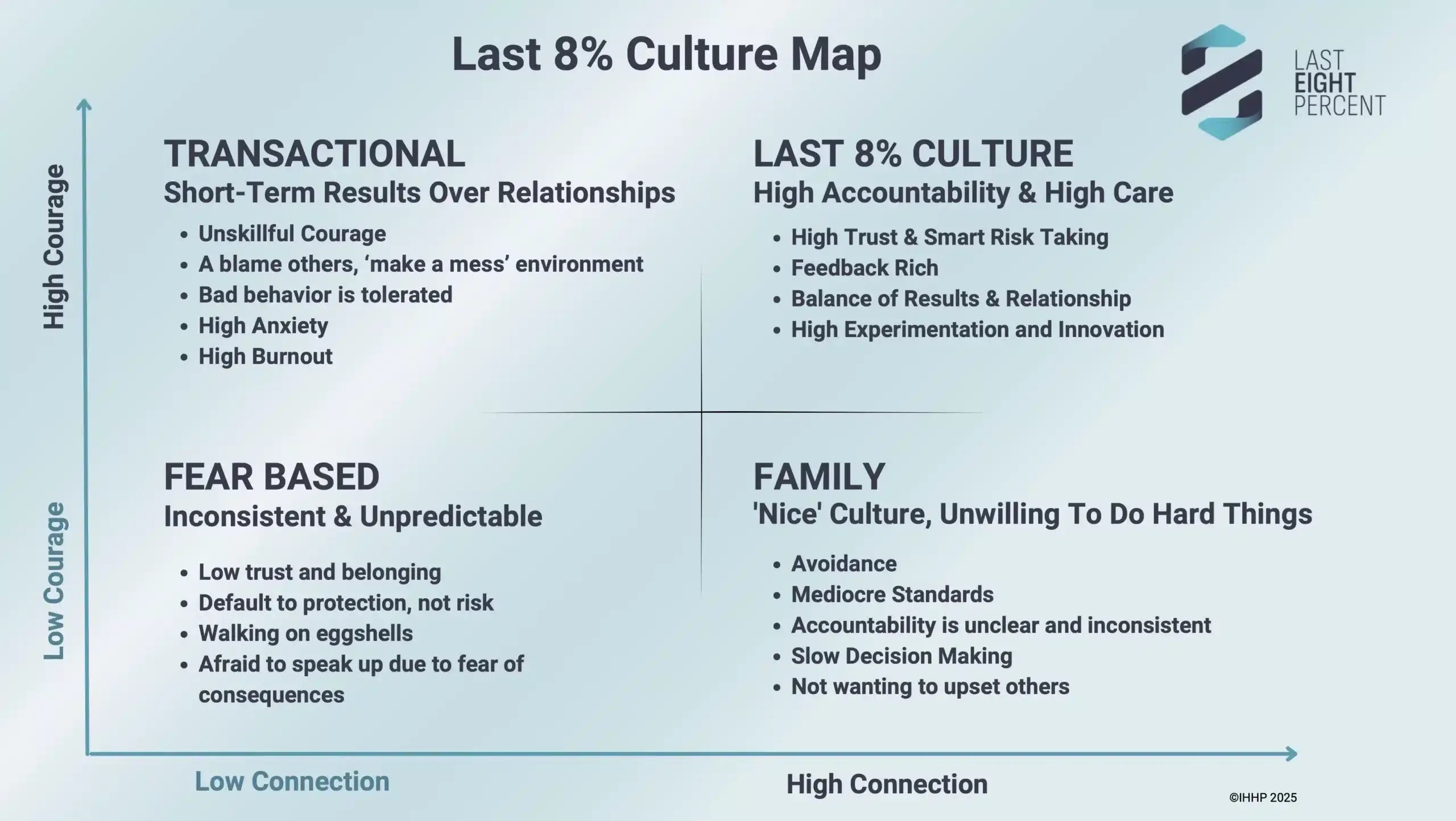
Patrick Lencioni’s Five Behaviors of a Cohesive Team® model provides a practical lens for understanding how teams move toward — or away from — a Last 8% culture. In particular, the behaviors of Trust and Conflict are foundational.
At the base of the Five Behaviors model is trust — specifically vulnerability‑based trust. Teams with strong trust believe it’s safe to:
Admit mistakes
Ask for help
Challenge ideas
Be honest about concerns
This aligns directly with the connection pillar of a Last 8% culture. Without trust, people protect themselves. With trust, they’re willing to take interpersonal risks — including stepping into the uncomfortable 8% of conversations that matter most.
However, trust isn’t built through good intentions alone. It’s built through consistent, predictable behavior. When teammates understand how others think, communicate, and respond under pressure, trust becomes easier to sustain.
Healthy conflict is where many teams struggle most — and where the Last 8% shows up most clearly.
Teams that avoid conflict often believe they’re being respectful or collaborative, but in reality they’re practicing artificial harmony. The result?
Slower decisions
Poorer outcomes
Frustration that leaks out sideways
A Last 8% culture reframes conflict as an act of care. Productive conflict:
Is focused on ideas, not personalities
Happens early, not after decisions are locked in
Strengthens trust when handled skillfully
This is exactly what the Five Behaviors model calls for — and exactly what many teams aspire to but struggle to execute.
Knowing that trust and conflict matter is one thing. Building the capability to do them well is another. This is where The Predictive Index® becomes a powerful enabler of both the Five Behaviors and a Last 8% culture.
PI helps teams develop a shared language around workplace behavior by making the invisible visible. By understanding individual work styles — needs, drives, communication preferences, and stress responses — teams gain:
Greater empathy for differences
Reduced misinterpretation of intent
Clearer expectations of one another
When people understand why a colleague pushes hard, hesitates, asks many questions, or prefers autonomy, trust accelerates. Behavior is no longer personal — it’s contextual.
Most conflict isn’t caused by disagreement; it’s caused by misaligned behavioral needs. PI enables teams to:
Anticipate friction points before they escalate
Adapt communication styles during difficult conversations
Separate intent from impact
This directly supports healthier conflict — allowing teams to challenge ideas robustly while maintaining respect and connection.
Leaders play a critical role in shaping culture. PI equips leaders to:
Flex their leadership style without losing authenticity
Deliver feedback with both clarity and care
Create norms where accountability and empathy coexist
When leaders model high courage and high connection, teams follow.
A Last 8% culture isn’t about being braver for bravery’s sake. It’s about creating the conditions where people can do hard things — because trust makes it safe and clarity makes it possible.
By combining:
The Five Behaviors (what great teams do)
The Last 8% research (why people hold back)
The Predictive Index (how people actually behave at work)
organizations gain a practical, scalable way to build teams that speak up sooner, challenge better, and perform at a higher level — without sacrificing relationships.
High‑performing teams don’t avoid discomfort. They understand it, manage it, and use it to move forward together.
That’s the power of closing the last 8%.
Understanding the Last 8%, the Five Behaviors, and workplace behavior is only valuable if it leads to action. Whether you’re just starting the conversation or ready to go deeper, here are several practical ways to move forward.
It's worth checking out the Last Eight Percent website, where you can pre-order their book and take an assessment for a $29.95 fee. Which we believe is excellent value for money, considering the impact this data can have. Alternatively, please find some additional options below.
If you haven’t already, a powerful next step is to explore Patrick Lencioni’s work, particularly The Five Dysfunctions of a Team. It provides essential context for why trust and conflict sit at the foundation of team performance and why so many teams struggle to sustain them.
From there, teams can:
Complete The Five Behaviors® Assessment, which provides clear insight into where your team is strong and where it’s stuck
Use the results as a shared, objective starting point for honest conversations
👉 Talent Optimizers can administer and debrief the Five Behaviors Assessment, ensuring insights translate into meaningful action rather than static reports.
Assessments create awareness; workshops create change.
A facilitated Five Behaviors workshop helps teams:
Build vulnerability-based trust
Learn how to engage in healthy, productive conflict
Translate insights into everyday team norms and behaviors
👉 Talent Optimizers designs and delivers Five Behaviors workshops that integrate behavioral insight, real-world application, and practical tools teams can use immediately.
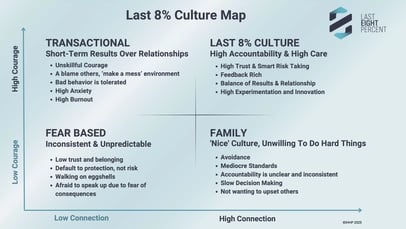
A simple but powerful exercise is to draw the Last 8% culture quadrants (Family, Transactional, Fear-Based, Last 8%) and ask your leadership team:
Where do we believe our team sits today?
Where would our employees say we are?
What behaviors are helping — or preventing — us from moving into the Last 8% quadrant?
This conversation alone often surfaces critical insights about trust, conflict, accountability, and psychological safety.
An external facilitator:
Creates psychological safety by removing hierarchy from the room
Challenges assumptions leaders may not even realize they’re making
Helps teams move beyond surface-level agreement into the real Last 8%
Time and again, organizations find that investing in an experienced facilitator leads to faster clarity, deeper trust, and more sustainable behavior change.
👉 Working with a third party isn’t a cost — it’s one of the highest-ROI investments you can make in team performance.
High-performing teams don’t just talk about trust and conflict — they deliberately design for them. By combining the Five Behaviors, the Last 8% framework, and behavioral insight from The Predictive Index, organizations can move from intention to impact — and build teams that consistently perform when it matters most.
.jpeg)
Learn how trust drives high-performing teams and how The Five Behaviors and Predictive Index help leaders build stronger, more aligned teams.
.jpeg)
Most CEOs shouldn’t chair meetings. Learn how aligning meeting leadership to the right behavioral profile improves decisions, engagement, and...
%20BLOG.jpeg)
Discover how the Predictive Index Employee Turnover Calculator reveals the true cost of mis-hires — and why behavioral and cognitive assessments are...