Behavioral Intelligence: The Next Evolution of AI at Work
What is Behavioral Intelligence? Discover how AI and behavioral science combine through Obi and The Predictive Index to help leaders build stronger...
4 min read
Damon Clark : Jul 6, 2026, 11:15:00 AM
.jpeg)
I couldn't agree more.
At Talent Optimizers, we spend much of our time helping leadership teams understand that behavior is rarely as simple as it first appears. What looks like insubordination to one leader may be innovation to another. What appears to be compliance may actually be fear. The behavior you see is only part of the story.
Where I'd add another layer to the conversation is through the lens of behavioral intelegence.
Specifically, how an individual's natural behavioral drives influence how they interpret rules, challenge decisions, and communicate disagreement.
Understanding this can dramatically improve leadership effectiveness.
One of the biggest takeaways from the HBR article is that leaders should avoid assuming all rule breaking is malicious.
Some employees break rules for personal gain. Others do it to help customers. Some feel pressured into it. Others genuinely believe they're acting in the organization's best interest.
Behavioral science doesn't change these motivations.
Instead, it helps explain how different people are likely to respond once they reach that point.
Two people may both believe a policy is wrong. One quietly raises concerns. Another ignores the policy entirely. A third follows it despite disagreeing.
The motivation may be similar. The behavioral expression is completely different.
The Predictive Index measures four primary behavioral drives that influence how we naturally approach work.
A – Dominance measures a person's drive to influence people and outcomes.
PI Hacks YouTube Factor A Deep Dive
B – Extraversion reflects how much someone seeks social interaction and collaboration.
PI Hacks YouTube Factor B Deep Dive
C – Patience measures comfort with consistency, stability, and pace.
PI Hacks YouTube Factor C Deep Dive
D – Formality reflects how strongly someone values rules, structure, accuracy, and established procedures.
PI Hacks YouTube Factor D Deep Dive
None of these factors are "good" or "bad." Every profile brings strengths.
However, each creates different tendencies when organizational rules are challenged.
One of the most misunderstood behavioral factors is Dominance.
High A individuals are independent thinkers. They naturally question assumptions. They're comfortable challenging authority. They're often willing to make difficult decisions without waiting for consensus.
When they believe a rule is preventing success, they may push back quickly.
If they feel the process is slowing progress, they may choose a different path.
Importantly, this doesn't mean they are unethical or prone to misconduct.
In fact, many of the world's best entrepreneurs, executives, founders and change leaders display high Dominance precisely because they are willing to challenge conventional thinking.
The leadership question becomes:
Have you created an environment where they can challenge the rule before they feel they need to work around it?
Great leaders don't try to suppress independent thinkers. They create healthy channels for constructive disagreement.
While the four primary factors are useful individually, some of the most powerful insights come from looking at combinations. The relationship between Patience (C) and Formality (D) is particularly important.
People with Higher Patience and lower Formality are worth highlighting.
These individuals typically enjoy moving quickly. They're comfortable with ambiguity. They're happy experimenting.
They often dislike bureaucracy and can become frustrated by excessive process.
When faced with a rule they believe slows progress, their instinct may be to ask:
"Is there a faster way?"
Conversely, someone with Lower Patience and higher Formality is often much more comfortable following established procedures.
They may see rules as providing consistency, fairness, quality, and risk reduction.
Neither approach is right or wrong. But if a leadership team contains both styles—as many do—they may interpret exactly the same behavior very differently.
One person sees innovation. Another sees unnecessary risk.
Without understanding these natural preferences, leaders can mistakenly turn behavioral differences into personal conflict.
Check a C:D Deep Dive on the PI Hack YouTube channel
If I had to identify one PI factor most closely connected to how people naturally view rules, it would be Formality.
Higher D individuals generally prefer:
Lower D individuals are typically more comfortable adapting processes when circumstances change.
They often ask:
"Does the rule still make sense?"
Neither is inherently better. Organizations need both.
One group protects standards. The other challenges outdated systems.
The healthiest organizations create environments where those perspectives improve one another rather than compete.
Several additional Predictive Index concepts can also influence how rule-breaking shows up.
Reference Profiles
Certain Reference Profiles naturally place greater emphasis on challenging the status quo, while others are more likely to value stability, consistency, and established processes. Remember, profiles don't predict ethics or misconduct—they simply influence how people prefer to solve problems.
PI Hacks YouTube Channel - Understanding Reference Profiles
Team Dynamics
Sometimes rule-breaking isn't an individual issue at all. It reflects the behavioral makeup of the team.
A leadership team dominated by independent, fast-moving profiles may unintentionally create a culture where "doing what works" gradually replaces agreed ways of working.
Conversely, a highly structured team may become so process-driven that innovation slows dramatically.
Behavioral diversity is valuable—but only when leaders understand how to harness it.
This is where I believe Patrick Lencioni's Five Behaviors framework adds another critical perspective.
When people repeatedly bypass agreed decisions, the issue often isn't the rule itself.
It's what happens to the team. Trust begins to erode.
Colleagues start wondering:
"Can I rely on them?"
Healthy conflict decreases because people stop raising concerns openly. Instead of debating ideas before decisions are made, individuals quietly choose their own path afterward.
This creates one of the most dangerous conditions in leadership teams:
Artificial harmony.
Everyone appears aligned in the meeting. Afterwards, people do something different. The conversation becomes polite. The execution becomes fragmented.
Over time, accountability declines because no one is truly committed to the decision that was made.
Ironically, teams often think they have low conflict when, in reality, they simply have low honesty.
The HBR article encourages leaders to understand the motivation behind rule-breaking before deciding how to respond.
Behavioral science takes that one step further.
It helps leaders understand why different people naturally approach rules, authority, and disagreement differently in the first place.
Rather than asking:
"Why did they break the rule?"
Leaders should also ask:
The best leaders don't simply enforce rules. They understand people.
Because when you understand behavior, you don't just manage compliance—you build cultures where people challenge the right things, in the right way, at the right time.
If you haven't read the original Harvard Business Review article, I highly recommend it. It's an excellent piece of research that explores why employees break rules and how effective leaders respond with curiosity rather than assumption.
My goal here wasn't to replace those insights, but to add another dimension through behavioral science. Understanding why someone breaks a rule is essential. Understanding how their natural behavioral drives shape that response can help leaders build stronger, healthier, and more effective teams.
What is Behavioral Intelligence? Discover how AI and behavioral science combine through Obi and The Predictive Index to help leaders build stronger...
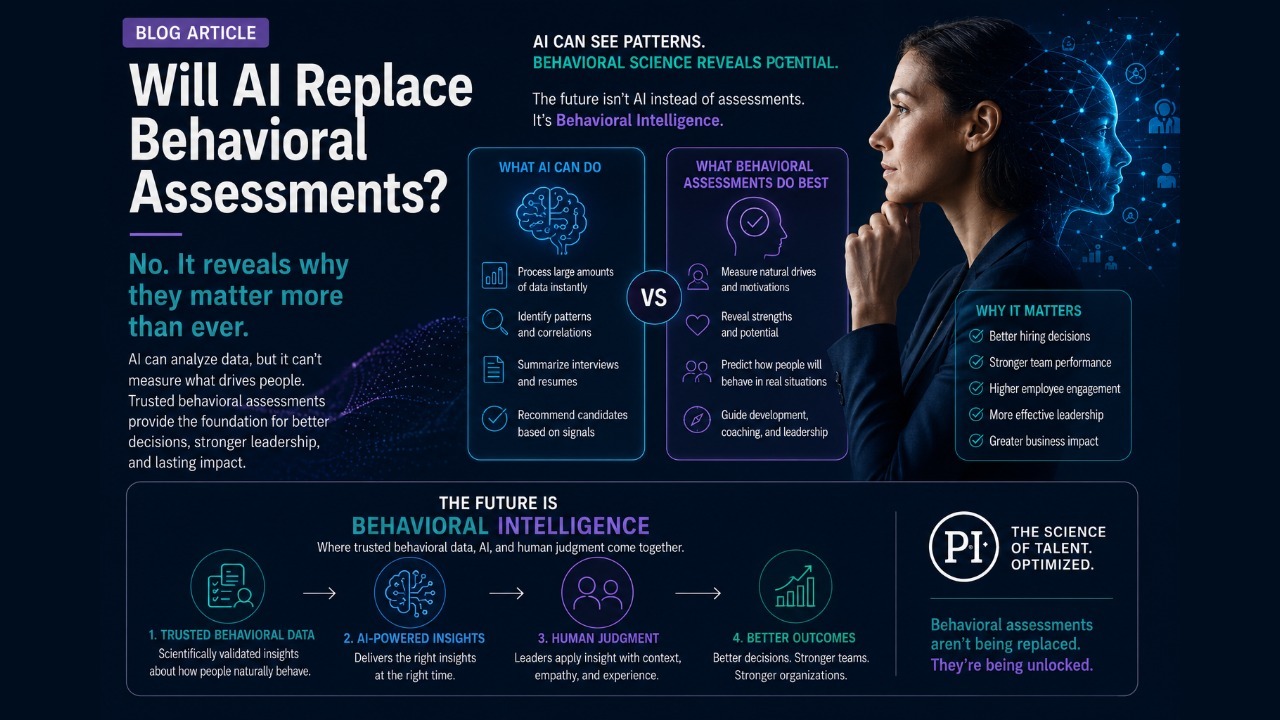
Will AI replace behavioral assessments? Discover why trusted behavioral data is becoming more valuable than ever and how Behavioral Intelligence is...
Do behavioral assessments still matter in an AI hiring world? Discover why trusted behavioral data is becoming more valuable than ever and how...