

Why Individual Talent Doesn’t Scale (And What Leaders Get Wrong About Meetings)
Most CEOs shouldn’t chair meetings. Learn how aligning meeting leadership to the right behavioral profile improves decisions, engagement, and...
4 min read
.jpeg)
When teams struggle, the issue is rarely strategy, capability, or even effort.
More often than not, the issue is trust.
When trust is strong, teams collaborate more openly, share ideas more freely, and are much more comfortable challenging each other in productive ways. When trust is weak, communication becomes guarded, people avoid difficult conversations, and even the best strategies struggle to succeed.
In other words, trust is not just a “nice to have” leadership quality. It is one of the most important foundations of high-performing teams.
The Harvard Business Review article highlights several practical behaviors that help leaders build trust within their teams. These ideas are simple, but they are incredibly powerful when applied consistently.
Some of the most important leadership habits include:
• Being consistent in decisions and behavior
• Communicating openly and transparently
• Following through on commitments
• Demonstrating genuine care for team members
• Creating psychological safety so people feel comfortable speaking up
None of these behaviors are particularly complicated.
But trust is rarely built through a single moment or initiative. Instead, it develops gradually through repeated interactions over time.
Every conversation, decision, and leadership action either strengthens trust or slowly erodes it.
One of the most well-known leadership models built around trust is The Five Behaviors framework created by Patrick Lencioni.
The model identifies five key behaviors that drive high-performing teams:
• Trust
• Healthy conflict
• Commitment
• Accountability
• Results
Trust sits at the very bottom of the model because it enables everything else.
Without trust, teams avoid conflict. Without healthy conflict, teams struggle to reach real commitment. Without commitment, accountability becomes difficult, and results suffer.
When we facilitate Five Behaviors workshops with leadership teams at Talent Optimizers, trust is almost always the first major breakthrough.
Once leaders begin to understand each other better, conversations become more honest, feedback becomes easier, and teams start making better decisions together.
While leadership habits and frameworks are incredibly helpful, there is another important factor that often gets overlooked: behavioral style.
Using the behavioral framework behind Predictive Index, we can see that different leaders naturally build trust in different ways.
Before exploring this further, it is important to emphasize a key principle of Predictive Index.
There are no bad behavioral profiles.
Every behavioral pattern has strengths and caution areas, and every profile is capable of leading people successfully. Leadership simply looks different depending on the behavioral style of the individual.
For example, a leader with a more analytical or structured behavioral style may build trust through reliability and consistency. Their team knows what to expect, decisions are thoughtful, and processes are clear.
Another leader may build trust through relationships and communication. Their team feels connected, supported, and encouraged to share ideas.
Neither approach is better. They are simply different.
Understanding those differences helps leaders build trust more intentionally.
One of the most powerful concepts within Predictive Index is the difference between Self and Self-Concept.
Your Self represents your natural behavioral drives. It reflects how you tend to behave when you are not adapting to external expectations.
Your Self-Concept reflects how you adjust those behaviors to succeed in your role or environment.
Great leaders understand where they may need to stretch their behavior to meet the needs of their team.
For example:
• A highly analytical leader may stretch extraversion to communicate more openly and frequently with their team.
• A highly social leader may stretch patience to slow down and listen more carefully when someone is sharing a concern.
These small adjustments can significantly strengthen trust within a team.
Because when leaders adapt their behavior intentionally, they create an environment where people feel heard, supported, and respected.
Trust is closely connected to employee engagement.
When people trust their leader, they are far more likely to:
• Share ideas and feedback
• Take ownership of their work
• Collaborate effectively with others
• Stay committed to the organization’s goals
When trust is missing, the opposite often happens. Communication becomes cautious, people avoid taking risks, and engagement slowly declines.
This is one of the reasons why engagement initiatives often struggle when leadership trust is weak.
Without trust, engagement efforts feel superficial.
With trust, engagement grows naturally.
Tools like Predictive Index Inspire can play a powerful role in helping leaders build trust within their teams.
Predictive Index helps leaders understand the behavioral needs and motivations of their team members, allowing them to communicate, coach, and manage more effectively.
Leaders can use these insights to:
• Understand how different team members prefer to communicate
• Recognize what motivates individuals at work
• Adapt leadership style to better support team members
• Identify potential friction points within teams
When leaders understand both their own behavioral tendencies and those of their team, they are able to build stronger relationships and foster deeper trust.
At Talent Optimizers, we often combine Predictive Index behavioral insights with the The Five Behaviors framework when working with leadership teams.
This combination helps leaders:
• Understand each other’s behavioral styles
• Build trust more quickly
• Have healthier conflict and conversations
• Strengthen accountability and alignment
These workshops often create powerful breakthroughs for leadership teams because they help leaders understand not just what behaviors build trust, but also how different personalities approach trust differently.
Trust is not created through a single initiative or training session.
It develops through consistent leadership behavior over time.
When leaders communicate openly, follow through on commitments, and show genuine care for their teams, trust grows naturally.
And when leaders combine those habits with behavioral awareness, they are able to build trust much more intentionally.
Because the strongest teams are not just aligned around strategy.
They are built on trust.
Better Work. Better World.
.jpeg)
Most CEOs shouldn’t chair meetings. Learn how aligning meeting leadership to the right behavioral profile improves decisions, engagement, and...
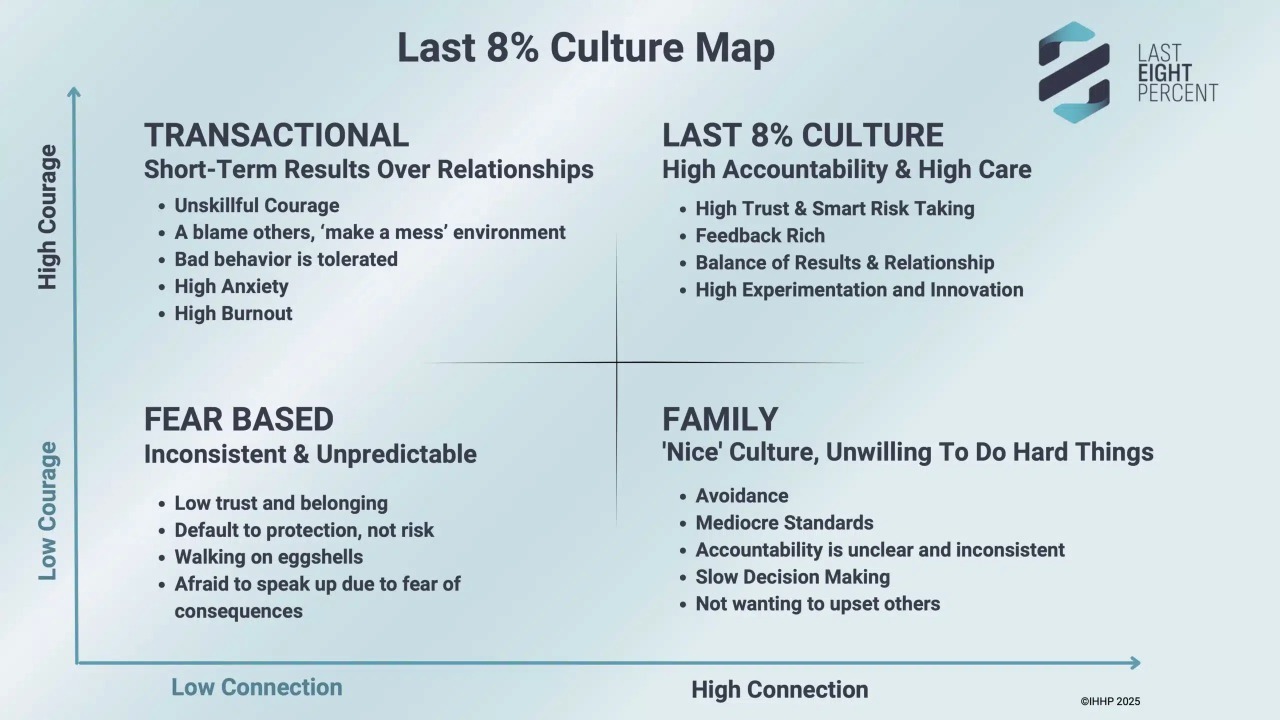
Discover how the Last 8% complements Predictive Index® and Five Behaviors® to build trust, improve healthy conflict, and create high-performing teams.
What is Behavioral Intelligence? Discover how AI and behavioral science combine through Obi and The Predictive Index to help leaders build stronger...