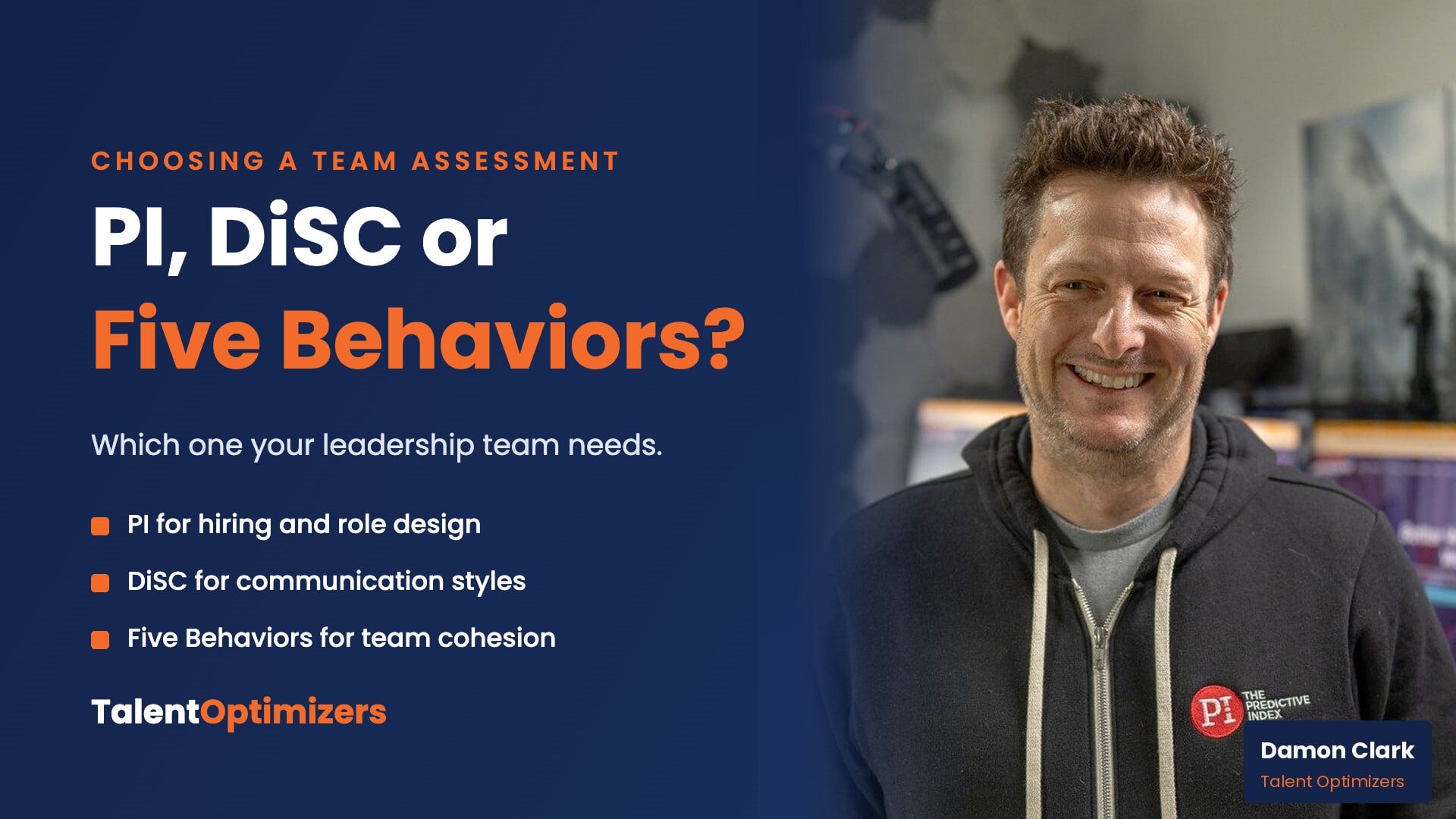
Your leadership team agrees it needs to work better together. HR comes back with three options: Predictive Index, DiSC and The Five Behaviors. Everyone asks the same question: which one is best? It's the wrong question. They don't compete. They answer different questions.
We're certified in all three and use them every week with leadership teams. The mistake we see most isn't picking the "wrong" tool. It's picking one tool to do a job it was never built for, like using a team-cohesion model to make a hiring decision, or a communication-style profile to design a role. This guide sets out what each tool measures, where each one wins, and how to combine them.
Quick answer: should you use Predictive Index, DiSC or The Five Behaviors?
Use Predictive Index when you need behavioral data across the whole talent cycle, especially hiring, role design and manager coaching. Use Everything DiSC when the goal is a simple, shared language for communication and working styles. Use The Five Behaviors when an intact team needs to build trust, healthy conflict, commitment, accountability and a focus on results. Many leadership teams get the best results combining PI or DiSC for individual insight with The Five Behaviors for team cohesion.
4 drives
measured by the PI Behavioral Assessment
4 styles
in the Everything DiSC model
5 behaviors
of a cohesive team (Lencioni)
60+
clients we support worldwide
How do Predictive Index, DiSC and The Five Behaviors compare at a glance?
The short version: PI and DiSC describe individuals; The Five Behaviors describes how a team works together.
Predictive Index
Everything DiSC
The Five Behaviors
What it measures
Four behavioral drives: Dominance, Extraversion, Patience and Formality
Four styles: Dominance, influence, Steadiness and Conscientiousness
How a team performs on Trust, Conflict, Commitment, Accountability and Results
Focus
Individuals, jobs and teams
Individuals and relationships
The intact team
Strongest use
Hiring, role design, manager coaching, team design
1What does the Predictive Index measure, and when is it the right choice?
The PI Behavioral Assessment measures four workplace drives: Dominance, Extraversion, Patience and Formality. People get one of 17 Reference Profiles, a quick snapshot of how they naturally work. PI also has a separate Cognitive Assessment.
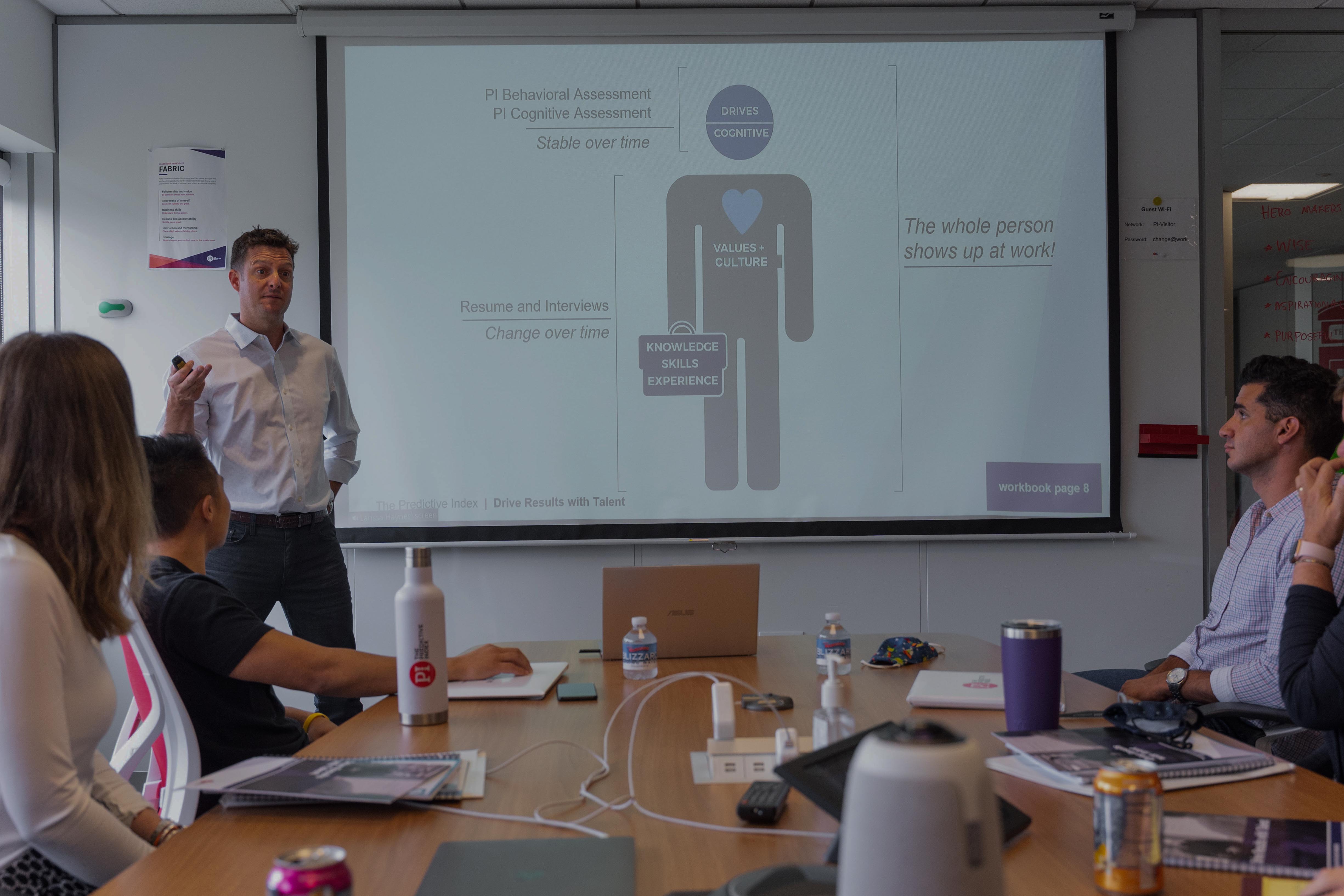
What sets PI apart is that it measures the job as well as the person. A Job Target defines the behaviors a role needs, so you can compare candidates and employees against it. That's why PI is the one we use for hiring, promotions and role design. Its software (Hire, Inspire, Design and Obi, PI's AI coach) keeps the data in front of managers after the workshop ends.
Damon Clark walking a team through PI's role in whole-person hiring.
Best for: hiring and promotion decisions, designing roles and teams, and giving managers day-to-day coaching data. Learn more about Predictive Index at Talent Optimizers.
2What does Everything DiSC measure, and when is it the right choice?
Everything DiSC, published by Wiley, describes four styles: Dominance, influence, Steadiness and Conscientiousness. Everyone is a blend of all four, usually with one or two that stand out, and no style is better than another. The model traces back to William Moulton Marston's 1928 work.
DiSC's strength is simplicity. People remember their style after one session, and teams start using the language straight away: "I'm a high S, give me a minute before you need an answer." It focuses on communication and working relationships rather than job requirements, so we don't use it to make hiring decisions.
Best for: communication training, onboarding into a team culture, sales and customer-facing skills, and organizations that want an accessible, shared vocabulary. See our Everything DiSC programs.
Try this: already have PI or DiSC data? Don't start again with a new tool. Ask whether your problem is about individuals (use what you have) or about how the team works together (add The Five Behaviors).
3What is The Five Behaviors of a Cohesive Team, and when is it the right choice?
The Five Behaviors is based on Patrick Lencioni's book The Five Dysfunctions of a Team (2002), developed with Wiley. It measures how an intact team performs on five behaviors that build on each other: Trust, Conflict, Commitment, Accountability and Results.
It's the only one of the three that assesses the team rather than the individual. It also includes each member's DiSC style, so people see how their style shows up in each behavior. It's designed for intact teams of roughly 5 to 13 people who have worked together for at least six weeks.
Best for: leadership teams with low trust, meetings where nobody disagrees, decisions that don't stick, and teams that let missed commitments slide. Explore The Five Behaviors with Talent Optimizers.
Build high-performing teams with The Five Behaviors and PI, from PI Hacks.
They're not competitors. They answer different questions.
4Which should a leadership team use?
Start with the problem, not the tool. Answer these four questions in order:
Are you making a people decision? Hiring, promoting or redesigning a role means you need job requirements and candidate data. Use Predictive Index.
Is the problem how people communicate? Friction between styles and misread messages respond well to a shared language. Use PI or DiSC, whichever you already have.
Is the problem how the team works together? Low trust, avoided conflict and weak accountability are team problems. Use The Five Behaviors.
Is it all of the above? It usually is for leadership teams. Combine them, and sequence the work so each tool builds on the last.
Can you use Predictive Index, DiSC and The Five Behaviors together?
Yes, and for leadership teams it's often the best answer. A typical sequence for us looks like this:
Talk it through with a partner certified in all three.
In a free 60-minute consultation we'll look at what your leadership team needs and recommend the right tool, or combination, before you spend a dollar on assessments.
Both describe individual behavior with four dimensions. Predictive Index measures four workplace drives and compares people with Job Targets, so it is used for hiring, role design and coaching. Everything DiSC describes four communication and working styles and is used mainly for training and relationships.
Predictive Index. It measures what the job needs through Job Targets and compares candidates against them. DiSC is built for development and communication rather than selection decisions.
A team development program based on Patrick Lencioni's The Five Dysfunctions of a Team. It measures how an intact team performs on Trust, Conflict, Commitment, Accountability and Results, and includes each member's DiSC style.
Yes. PI explains how each individual is wired and how they fit their role; The Five Behaviors builds how the team works together. Talent Optimizers often combines them for leadership teams.
It depends on the problem. Use PI for people decisions, PI or DiSC for communication, and The Five Behaviors for trust, conflict and accountability. Most leadership teams benefit from an individual tool plus The Five Behaviors.
Yes. Talent Optimizers is a certified Predictive Index partner and is certified in Everything DiSC and The Five Behaviors of a Cohesive Team, serving 60+ clients worldwide.
Sources: Wiley, Everything DiSC model and Theory and Research overview; Wiley, The Five Behaviors Team Development brochure and research report; Lencioni, P. (2002), The Five Dysfunctions of a Team, Jossey-Bass; The Predictive Index, Introduction to the PI Behavioral Assessment.
About the author: Damon Clark is CEO of Talent Optimizers, a certified Predictive Index partner serving 60+ clients worldwide, and runs PI Hacks, the largest PI-focused YouTube channel. He previously worked at The Predictive Index and is certified in Everything DiSC and The Five Behaviors of a Cohesive Team.