4 min read
"Do you think AI will eventually replace behavioral assessment debriefs?"
It's one of the most interesting questions I've been asked this year, and I suspect it's on the minds of many HR leaders.
After all, AI can already summarize meetings, analyze documents, answer complex questions, and write remarkably good content. If it can do all of that, surely it won't be long before it can explain a behavioral assessment more effectively than a consultant or coach.
It's an understandable assumption.
But I think it's based on a misunderstanding of what a great assessment debrief actually is.
Because the purpose of a behavioral assessment isn't simply to explain a profile.
It's to help someone understand themselves.
And those are two very different things.
Information Isn't the Same as Insight
One of the biggest mistakes people make is assuming that if someone understands a behavioral report, they'll automatically know what to do with it.
In reality, that's rarely the case.
Over the years, I've debriefed thousands of Predictive Index Behavioral Assessments. I've sat with CEOs, graduates, frontline managers, founders, engineers, and executive leadership teams. What's always fascinated me is that no two conversations are ever the same, even when two people have exactly the same reference profile.
Why?
Because behavior doesn't exist in isolation.
It's influenced by the role someone is in, the culture they're working within, the experiences they've had, the manager they report to, and the challenges they're currently facing.
The report provides the science.
The conversation provides the context.
And that's where the real value is created.
Where AI Is Already Better Than Humans
Now, before anyone thinks I'm anti-AI, let me say the opposite. I use AI every day, and I think it's one of the biggest technological shifts we've seen in decades.
In fact, there are already several things AI does better than any consultant ever could.
It never forgets the assessment.
It instantly remembers every behavioral factor, every combination, and every recommendation. It can compare patterns across thousands of situations in seconds, explain concepts consistently, and make behavioral science available to managers whenever they need it. That's remarkable.
I've spent years training managers to understand behavioral data. AI can now make much of that knowledge available in a matter of seconds.
From an accessibility perspective, that's a game changer.
But Here's What AI Doesn't Do
What AI can't do—at least not today—is sit across the table from someone and notice the hesitation before they answer a question.
It can't see the smile when someone finally recognizes a pattern that's been shaping their career for years.
It can't hear the uncertainty in someone's voice when they admit they're exhausted from trying to behave like somebody they're not.
Those moments matter. Some of the most powerful assessment debriefs I've ever facilitated have had very little to do with explaining the report itself.
They've been about helping someone connect the dots between their behavioral drives and the experiences they've had throughout their career.
Sometimes that requires challenging assumptions.
Sometimes it requires asking uncomfortable questions.
Sometimes it simply requires silence while somebody processes what they've just realized.
That's not about interpreting data. That's coaching.
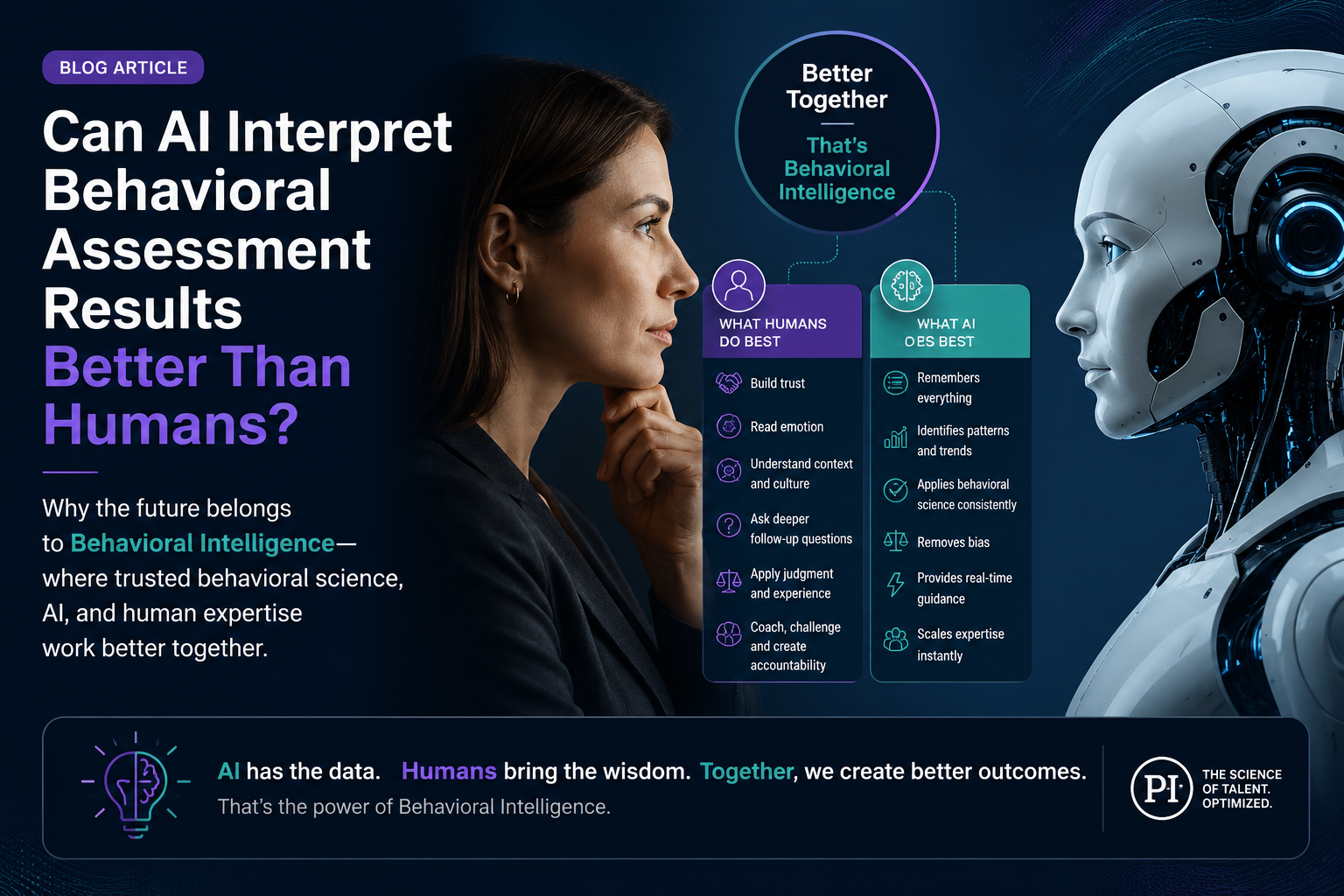
The Real Question Isn't AI vs Humans
I actually think we're asking the wrong question.
The question isn't whether AI interprets behavioral assessments better than humans.
The question is whether AI and humans together can create a better experience than either could alone.
I believe the answer is unquestionably yes.
Imagine a manager preparing for their first one-to-one with a new employee. Traditionally, unless they'd been extensively trained, they'd probably skim through the assessment report and hope they remembered the important points.
Now imagine they have instant access to guidance that's grounded in validated behavioral science, tailored to the individual sitting opposite them and available exactly when they need it.
That manager walks into the meeting more prepared, more confident, and more likely to build trust from day one.
That's not AI replacing the manager.
It's AI making the manager better.
This Is Where Behavioral Intelligence Begins
This is why I believe we're entering a completely new era. For years we've used behavioral assessments to understand people. Behavioral Intelligence helps us apply that understanding. It combines trusted behavioral science, organizational context, and AI to help leaders make better decisions in real time.
Not generic advice. Not internet wisdom.
Advice that's relevant to the individual, the situation and the conversation they're about to have.
That's a profound shift.
Why Obi Excites Me
This is exactly why I've become excited about Predictive Index Obi. Not because it can explain a behavioral report. Most experienced consultants can already do that. What excites me is that Obi makes behavioral expertise available every day.
Managers don't just need help during onboarding. They need help before interviews. Before performance reviews. Before difficult conversations. During organizational change. When coaching someone who's disengaged. When resolving a conflict between two colleagues.
Those are the moments that shape culture.
And that's where Behavioral Intelligence becomes incredibly powerful.
The Future Isn't AI Replacing Coaches
Here's my prediction.
The organizations that get the greatest value from AI won't replace their consultants, coaches, or HR teams.
They'll free those experts to spend more time doing what humans do best. Building trust. Facilitating difficult conversations. Helping leaders grow. Developing culture. Supporting change.
Meanwhile, AI will handle the things it does best—making behavioral science instantly accessible, consistent and available whenever it's needed.
That's not competition.
That's partnership.
Final Thoughts
So, can AI interpret behavioral assessment results better than humans? Sometimes.
It can certainly explain behavioral science faster, more consistently, and more accessibly than most people.
But the most valuable part of a behavioral assessment has never been the explanation.
It's the conversation that follows.
The future doesn't belong to AI. The future doesn't belong to humans. It belongs to organizations that combine both through Behavioral Intelligence. Because AI can explain a behavioral profile.
But great leaders help people change.
And that's a distinction worth remembering.