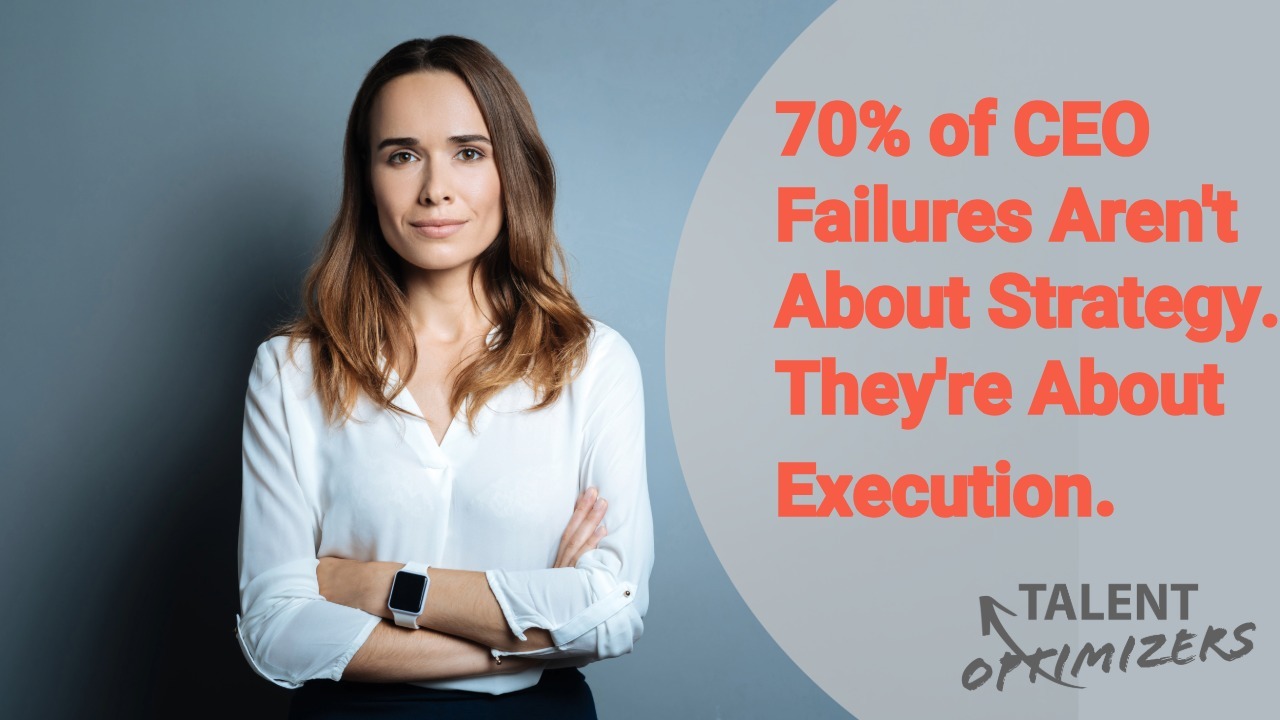
70% of CEO Failures Aren't About Strategy. They're About Execution.
Fortune says 70% of CEO failures come from poor execution, not bad strategy. Here's why — and how to measure your organization's execution health.
6 min read
A recent Harvard Business Review article, Our Favorite Management Tips on Setting Strategy When the Path Is Unclear, caught my attention because it addresses a challenge almost every leadership team is facing: How do you set direction when you don't have all the answers?
Uncertainty is nothing new, but the pace of change facing organizations today makes this question increasingly important. Leaders are being asked to make decisions about AI, technology, changing customer expectations, economic uncertainty, new competitors, and evolving ways of working—often without the luxury of waiting until all the data is available.
There are plenty of frameworks that can help organizations develop strategy in uncertain environments. But there is another dimension that is often overlooked:
Behavior.
You can have a perfectly reasonable strategy on paper, but ultimately people have to challenge it, make decisions, communicate it, adapt it, and execute it.
This is where behavioral data—and specifically the Predictive Index—can become incredibly valuable.
When strategy is clear and the operating environment is relatively stable, organizations can build processes, establish responsibilities, and execute against a reasonably predictable plan.
When the path is unclear, the behavioral requirements change.
You need people who are comfortable moving forward without having every answer. You need people willing to challenge assumptions. You need others who can bring the organization with them. You need people who can translate an emerging strategy into action. And importantly, you need people who are willing to slow everyone down occasionally and ask, "Are we sure this is the right decision?"
One behavioral style isn't going to provide all of those things.
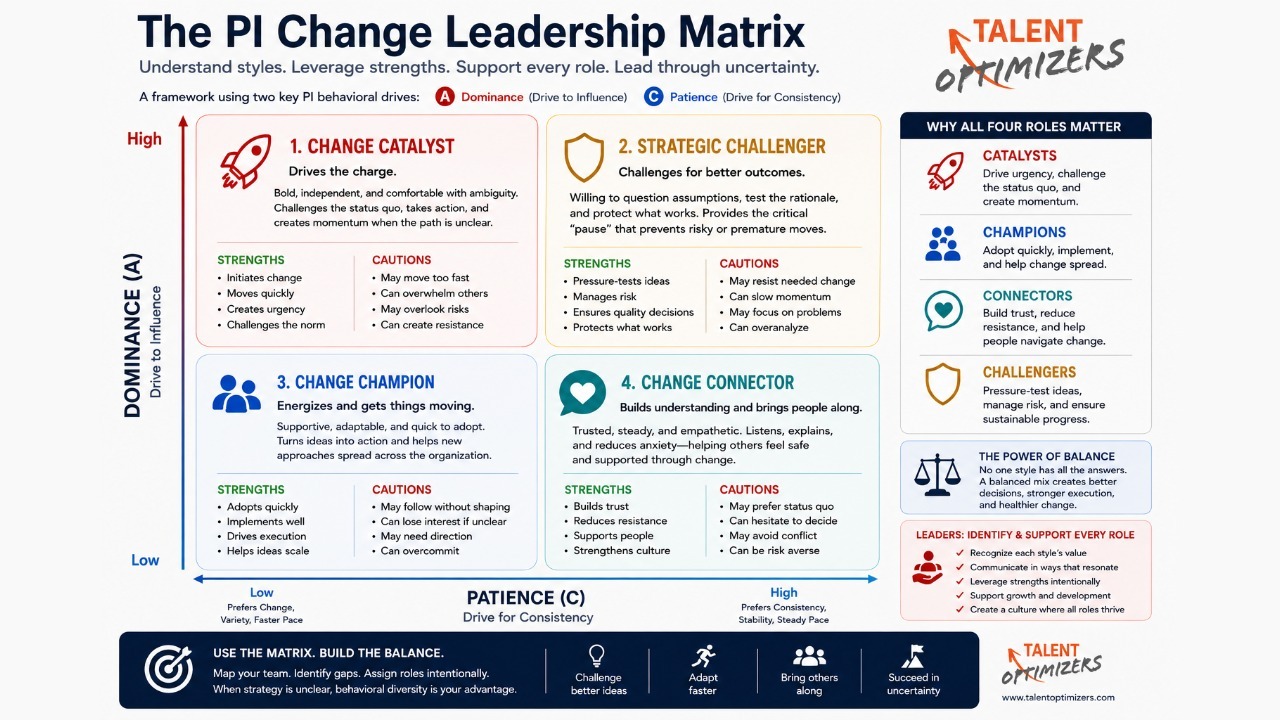
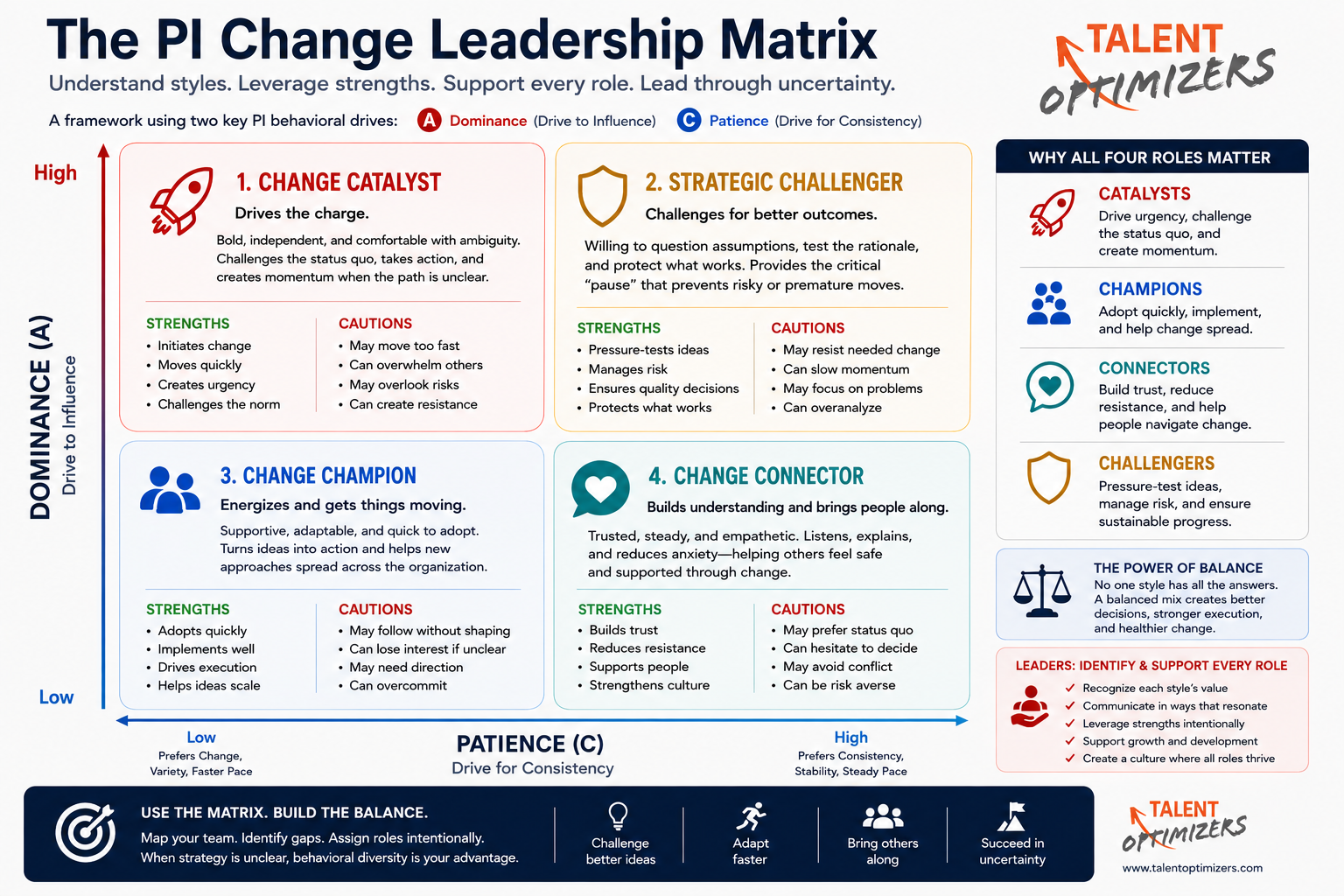
That's why I like looking at change through two of the Predictive Index's behavioral drives: Dominance (A) and Patience (C).
Dominance measures the drive to exert influence over people or events. Patience measures the drive for consistency and stability.
Put those two dimensions together and we can start thinking about four very different—and equally important—roles people can play when an organization is navigating uncertainty.
These are often the people we immediately associate with organizational change.
A high Dominance drive creates a natural desire for independence, challenge, influence, and control over events. A low Patience drive creates a need for variety, faster pace, and freedom from repetition.
Combine the two and you frequently have someone who doesn't just tolerate change—they may actively create it.
When the strategy is unclear, these individuals can be enormously valuable because they're often comfortable saying:
"We don't know everything yet, but we know enough to move."
They can challenge the status quo, push decisions forward, experiment, and create momentum while others are still trying to understand what is happening.
There is another PI factor that can amplify this: low Formality (D).
Formality reflects someone's drive for rules and structure. Someone with lower Formality tends to have a greater need for flexibility and freedom from rules. When Dominance is higher than Formality, PI describes the individual as generally more comfortable taking risks.
Put high A, low C, and low D together and you potentially have an incredibly powerful change agent: independent, fast-paced, comfortable with ambiguity, flexible, and willing to take calculated risks.
Of course, strengths can become cautions.
Move too quickly and you can leave the organization behind. Challenge too aggressively and you can create unnecessary resistance. Take too many risks and experimentation becomes chaos.
That's why change agents need the other three groups.
These individuals can sometimes be overlooked because they may not feel the same need to personally drive the strategy.
But they can be extremely important to making change happen.
Lower Dominance tends to bring a more cooperative, accommodating approach, while lower Patience still creates a preference for variety, change, and a faster pace.
In other words:
"I don't necessarily need to be the person driving the change, but I'm comfortable getting behind it."
These can be some of your earliest adopters.
Once they understand the direction, they may adapt quickly, experiment with new approaches, and help turn a leadership idea into everyday behavior.
This is an important distinction. Organizations don't need 100 change agents. In fact, an organization full of people all independently trying to redefine the strategy could become dysfunctional very quickly.
You need people who can embrace change without needing to own it.
When strategy is evolving, these individuals can provide agility throughout the organization.
This is perhaps the group leaders are most likely to underestimate during periods of rapid change.
Lower Dominance often brings cooperation, reassurance, and a desire for harmony. Higher Patience brings a preference for consistency, stability, and a steady pace.
At first glance, that might sound like someone who could resist change.
But that's far too simplistic.
These people can play an enormously important role because they often understand what the rest of the organization needs in order to come along on the journey.
While the Change Agent is saying:
"Come on—we need to move!"
the Change Whisperer may be asking:
"How is everyone doing with this?"
They can listen. They can provide reassurance. They can identify where uncertainty is creating anxiety or confusion. They can help leaders understand why people aren't adopting the new strategy as quickly as expected.
And critically, they can help translate change into something that feels manageable.
These aren't necessarily the people you ask to kick the door down.
They're the people who can make sure everyone else walks through it.
The name "Change Disruptor" may initially sound negative. I don't mean it that way.
In fact, this person can be one of the most valuable voices in the room.
High Dominance means they're comfortable challenging, questioning, and exerting influence. But higher Patience means they may also value stability, consistency, and a more deliberate pace.
That combination can create someone willing to say:
"Hold on. Why are we changing this?"
When everyone else gets excited about the latest idea, technology, acquisition, restructuring, or strategic pivot, these individuals can provide productive resistance.
They aren't necessarily resistant to change itself.
They may simply require a stronger case for why the change is necessary.
That distinction is incredibly important.
Good strategy requires momentum, but it also requires challenge.
Organizations need people willing to pressure-test assumptions, question whether the organization is moving too quickly, and protect the things that are already working.
Your Change Agents may push the organization forward.
Your Change Disruptors can stop them driving it off a cliff.
This is where behavioral analytics becomes particularly interesting.
When organizations face uncertainty, the natural reaction can be to look for more "entrepreneurial" people: decisive, fast-moving, independent, risk-tolerant leaders.
Those behaviors certainly have value.
But imagine a leadership team consisting entirely of high-A, low-C, low-D leaders.
Who slows the conversation down?
Who asks whether employees understand the change?
Who protects operational stability?
Who challenges the assumption that the latest idea is actually a good one?
Who thinks about implementation?
And who brings everyone else along?
The goal shouldn't be to identify the best behavioral profile for change.
There isn't one.
The better question is:
Do we have the behavioral diversity required to navigate change successfully?
This is where the Predictive Index can move beyond being viewed simply as a hiring assessment.
Take your leadership team—or even an entire project team—and map people against Dominance and Patience.
You may discover that your team is heavily concentrated in one quadrant.
Perhaps you have plenty of Change Agents generating ideas and pushing the organization forward, but very few Change Whisperers helping people absorb those changes.
Perhaps you have an organization full of Change Embracers who will readily support a new direction—but nobody willing to take ownership and drive it.
Or perhaps you have several Change Disruptors who are excellent at identifying risk and protecting stability, but not enough people naturally pushing for experimentation and speed.
None of those behavioral styles is inherently good or bad.
The issue is balance and awareness.
Once leaders understand the behavioral composition of the team, they can deliberately decide who should play which role as the strategy develops.
A and C provide a useful starting framework, but I wouldn't stop there.
Formality can tell us something important about how comfortable people may be operating without established rules, processes, or precedent.
Lower-D individuals generally prefer flexibility and freedom from rules. Higher-D individuals tend to seek clarity, accuracy, structure, and clearly defined expectations.
When the path is unclear, you need both.
Your lower-D people may be comfortable experimenting when the playbook hasn't been written yet.
Your higher-D people may be the ones who eventually turn successful experiments into a repeatable playbook.
Again, that's behavioral diversity working for you rather than against you.
The HBR article is fundamentally about making strategic decisions when the destination—or at least the route—isn't completely clear.
Behavioral data adds another question to that conversation:
Who do we need around the table while we figure it out?
You need people who will drive change.
You need people who will embrace it.
You need people who will help others navigate it.
And you need people willing to challenge it.
The Predictive Index gives leaders a common language for understanding those different behavioral needs.
Because when strategy is unclear, the answer isn't simply to move faster.
It's to understand who will push, who will follow, who will stabilize, and who will challenge—and then deliberately use all four.
That may be one of the most overlooked advantages of behavioral data in strategy.
Your strategy tells you where you want to go. Behavioral data helps you understand whether you have the people—and the behavioral diversity—to get there.
Fortune says 70% of CEO failures come from poor execution, not bad strategy. Here's why — and how to measure your organization's execution health.
.jpeg)
 Sandra Coker : Jul 19, 2026, 11:45:00 AM
Learn how to turn learning and development into a measurable retention strategy using the right metrics, behavioral insights, and proven best...
.jpeg)
Discover the five essential keys to successful strategy execution every leadership team should measure to enhance performance, innovation, and...